Meeting NOTICE:
Happy Friday!
Here's your first notice for MIDCO next week. We'll finally have a long-awaited presentation from the applicant on the Hoadly Square application next Thursday. The property consists of approximately 56 acres along the north side of Hoadly Road approximately 645 ft. west from the intersection of Hoadly Road, Galveston Court, and Ridgefield Village Drive and includes the Criswood Horse Farm. The property is mostly designated ORPA, Occoquan Reservoir Protection Area, which is limited to 5-acre lot size average, with some RN-2, Residential Neighborhood, which is meant as single-family homes on 1/4-acre to 1-acre lots along Hoadly Road, and a smaller portion of MU-3 near the existing shopping center. The applicant proposes to increase the housing density on the project over what's currently planned by requesting a Long-Range Land Use ("LRLU") map change to MU-3, Mixed Use with a T-3 Transect and rezoning the property from A-1, Agricultural to PMR, Planned Mixed Residential. This would allow for 64 multifamily units, 216 two-over-two multifamily units, and 152 single-family attached units. They're seeking a height modification to increase the allowable height for the townhomes and multifamily stacked residential units on the Property to 45 ft. and 55 ft. respectively, and other waivers and modifications. The total number of dwelling units proposed by the Applicant is 432.
We'll also have a presentation from the applicant on the Gibson's Crossing project (previously the Geisler Project).
This is a request to rezone ±8.8 acres from B-2, Neighborhood Business, to PMR, Planned Mixed Residential, with associated development waivers and modifications, to allow for the development of up to 192 age-restricted multi-family units.
Finally, we'll have a presentation on the Gilbeth Road Rezoning. This is a request to rezone from A-1, Agricultural to SR-5, Semi-Rural Residential to allow for one single-family detached home at 6990 Gilbeth Road off of Kahn's Road.
We'll also feature a report from the Sustainability Commission and the Citizens Advisory Board, updates on any other project that we have information on.
All next Thursday, April 18th at 7pm via Zoom. The invitation is below. If you have trouble with the link below, on the night of the meeting you can just open the Zoom website, click on "Meetings", then click on "Join", and enter Meeting ID: 874 1056 6842, and Passcode: 477820.
See you there!
You are invited to a Zoom meeting.
When: Apr 18, 2024 07:00 PM Eastern Time (US and Canada)
Register in advance for this meeting:
https://us02web.zoom.us/meeting/register/tZMpdumtqD0iHta2IGHtbNPMZspQhFzCF0OA
After registering, you will receive a confirmation email containing information about joining the meeting.
Working With Residents And Government To Protect And Improve Our Quality Of Life
MIDCO is a citizens group whose goal is to assist residents in assessing and affecting issues that impact our community. We strive to provide transparency on all issues so the community can make decisions based on the facts. We have worked on various issues since 2005 from land use to historical record to community services. We are independent, non-profit and unaffiliated with any political party or political organization. We always welcome and encourage public participation and urge mid-county residents to join us. Our area of influence includes the Coles and western Occoquan magisterial districts and is roughly defined by, but not limited to, the area between Hoadly Road and Liberia Avenue and between Route 234 and the Occoquan reservoir.
We will try to cut through the hype and hyperbole and gather factual information to keep residents informed on issues that could affect them.
MIDCO will also advocate on behalf of residents in situations where we feel it's warranted.
We are interested in maintaining and enhancing the quality of life in our area. MIDCO is open to all Prince William County residents and homeowners associations. Join us and help shape our future.
With your help, we can truly make a difference!
Our regular meetings are usually on the third Thursday of the month.
Contact us at: midcopw@gmail.com
The Development Process
- The project is submitted to the Planning Office by the applicant.
- County planning staff have meetings with the applicant and review the project.
- The project is reviewed and commented on by all pertinent county offices- Watershed Management, Schools, Parks, Transportation, etc.
- The staff has back-and-forth discussions with the applicant. The applicant submits updated versions to address staff concerns/suggestions.
- The applicant requests a Planning Commission Public Hearing date.
- The Planning Commission holds a public hearing and either makes an up or down recommendation to the Board Of County Supervisors (BOCS) or defers the decision.
- The application goes to the BOCS public hearing, usually a month later. The BOCS defers or makes final up or down decision on project.
Citizen Participation Opportunities
You can check the plan’s details on line (http://egcap.pwcgov.org/CAPSite/Public/Main) or in person at the Planning Office at 5 County Complex Court in Woodbridge. You can have copies made at the Planning Office for a fee.
- Ask questions! The county staff is happy to answer questions by e-mail or in person.
- Citizens can comment to staff on the application in writing and it will be included in the staff report.
- Public hearing dates will be listed on the page linked above. The agenda for either the BOCS or Planning Commission is also available on the county website. From the main page, click on the BOCS or “Appointed Boards” tab.
- Citizens can speak at the public hearings at the Planning Commission and BOCS when the agenda item is called. They usually allow 2-3 minutes per person. Citizens can also e-mail or call their Planning Commissioners or BOCS representatives. Contact information is available on the county website: http://www.pwcgov.org/gov
- You can also schedule a personal visit with individual Planning Commissioners or BOCS members.
Occoquan Reservoir- Rare Gem or Lost Opportunity?
It may seem to most folks, if they think about it at all, that the Occoquan Reservoir is doing fine. It is true that major improvements were made in the 1970’s when Fairfax County down-zoned hundreds of acres on the north side of the reservoir and the UOSA sewage treatment plant replaced the numerous polluting plants then in existence on the reservoir.
So why should we spend more effort (and money) to further improve the water quality of a reservoir that’s doing ok? Because ok is not good enough- the reservoir’s health is still far from what it could be, and what it once was. Sedimentation input results in knee-deep mud along the bottom of the reservoir that reduces water capacity and aquatic diversity, the clarity of the water is poor, aquatic grasses grow unchecked that inhibit fish stocks and diversity, and on and on.
The reality is that more work still needs to be done. The challenges are somewhat different now, but they still need to be addressed, now more than ever. The reservoir is impacted by sediment runoff from new development and stormwater runoff problems. Chemical pollution from treatment processes and pharmaceuticals such as antibiotics, hormones and steroids flow from the sewage treatment plant into the reservoir. Nutrient pollution from improper lawn and garden treatment remains an issue. The list is long.
The Occoquan Reservoir is a rare gem in our increasingly developed area. It is already an irreplaceable drinking water source for more than one million people. It can be an oasis from the cement and asphalt world that many of our children endure. It can be a green space that binds a community together, like Central Park in New York. It can be a place to swim, fish, enjoy clear water, beautiful rock formations, birds such as Herons and Eagles, and naturally diversified wildlife in the water, air and on land. We can do better and if we do, the Occoquan Reservoir area will be an economic and environmental boon for the county.
The Occoquan Overlay District now under consideration by the county is an excellent tool to start to achieve this goal. The intent of this overlay district is to increase protection for the Occoquan Reservoir and its tributaries by promoting new and existing processes that minimize point and nonpoint source pollution and by minimizing housing density in sensitive areas. You can read more about the Overlay District as it progresses at: midcopw.net and pwconserve.org.
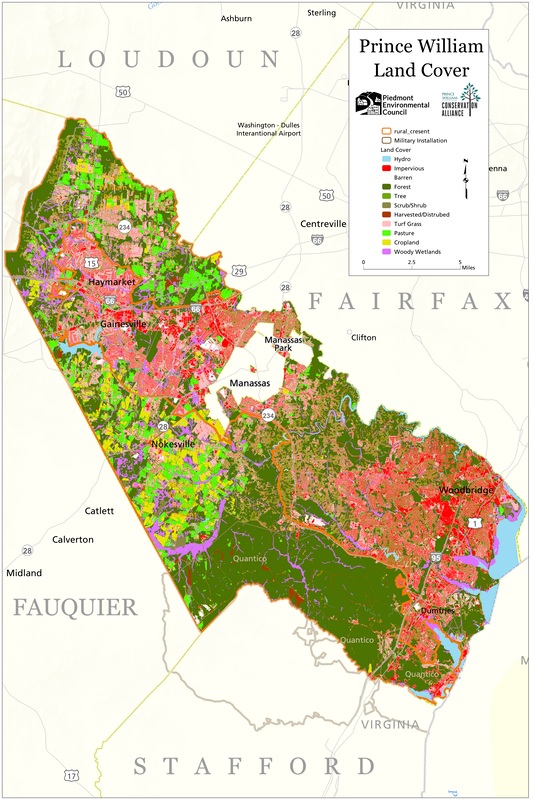
The map below shows in graphic detail how important the mid-county area is to the environmental health of the county. The most treed area of the county is mid-county, in addition to the streams and reservoir that are recreational gems.